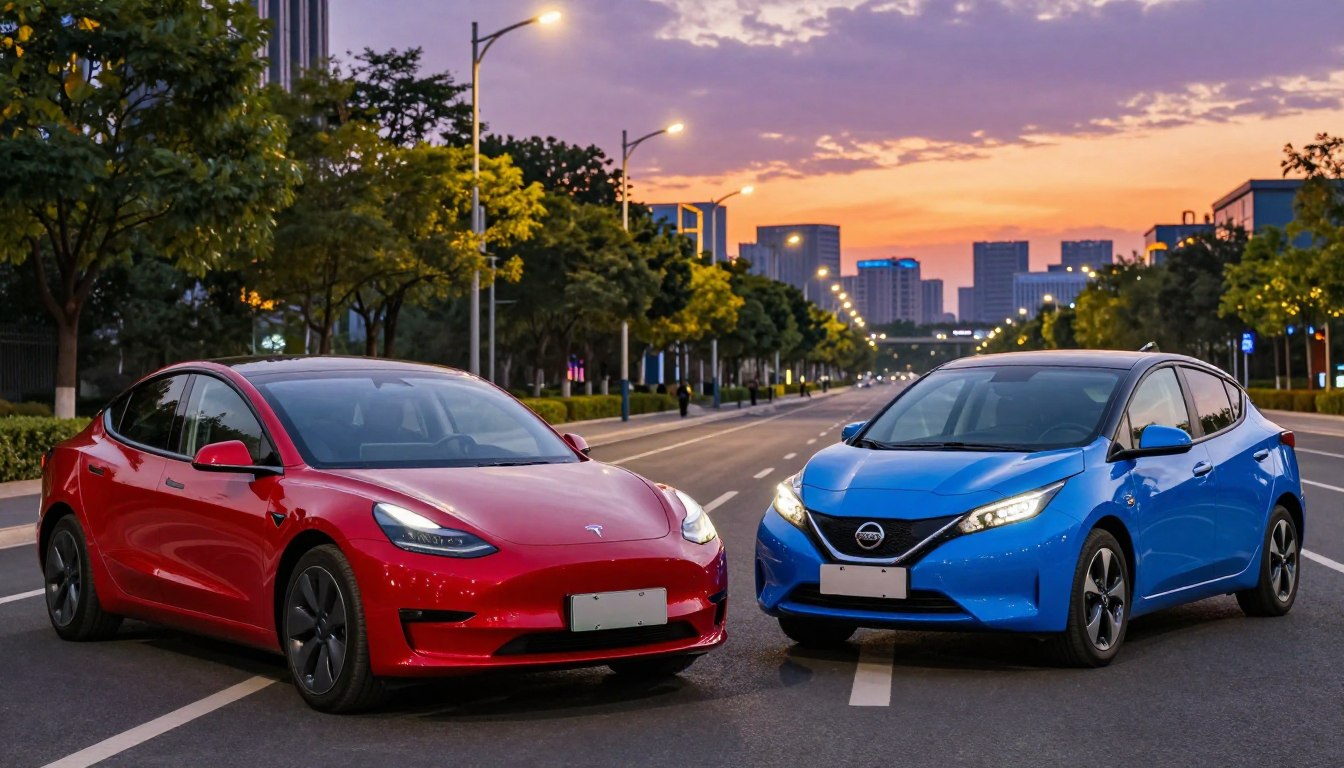
Have you ever wondered if the perfect electric vehicle is already sitting in a showroom waiting for you? As the automotive world shifts toward a greener future, choosing the right ev can feel like a daunting task.

We are diving into a head-to-head comparison between the popular Tesla Model 3 and the reliable Nissan Leaf. Both cars offer unique benefits, but they cater to very different driving needs.
Throughout this guide, we will examine electric car efficiency, performance, and overall value. Whether you prioritize cutting-edge technology or budget-friendly practicality, we will help you decide which machine fits your lifestyle best.
Key Takeaways
- Understand the core differences between the Tesla Model 3 and the Nissan Leaf.
- Evaluate how each ev performs in daily commuting scenarios.
- Learn about the importance of electric car efficiency for long-term savings.
- Discover which vehicle offers the best technology for your budget.
- Gain confidence in choosing the right electric vehicle for your specific needs.
The Evolution of the Electric Vehicle Market
As we look back, the evolution of electric vehicles has been nothing short of remarkable, paving the way for modern EVs like theTesla Model 3andNissan Leaf. The journey of electric vehicles (EVs) from their humble beginnings to the current thriving industry is a story of innovation and perseverance.
The early 2000s saw the introduction of the first modern electric vehicles, which were often criticized for their limited range and high prices. However, these initial models laid the groundwork for future advancements.Technological innovationsin battery technology, particularly the development of lithium-ion batteries, significantly improved the range and efficiency of EVs.

One of the key milestones in the evolution of the EV market was the introduction of theNissan Leafin 2010. As one of the first mass-market electric vehicles, the Leaf played a crucial role in popularizing EVs among a wider audience. Its success demonstrated that electric cars could be practical and appealing to a broad range of consumers.
The entry ofTeslainto the market marked another significant turning point. Tesla’s focus on creating high-performance, long-range electric vehicles challenged the conventional perception of EVs. TheTesla Model 3, in particular, has been instrumental in driving the mainstream adoption of electric vehicles, offering a compelling blend of performance, range, and affordability.
The growth of the EV market has also been supported by government policies and incentives aimed at reducing carbon emissions and promoting sustainable transportation. These incentives have varied by country and region but have generally included tax credits, rebates, and investments in charging infrastructure.
Today, the electric vehicle market is more diverse than ever, with numerous manufacturers offering a range of EV models. The advancements in technology and the expansion of charging infrastructure have made EVs more accessible and convenient for consumers. As the industry continues to evolve, we can expect further improvements in range, performance, and affordability, making electric vehicles an increasingly attractive option for car buyers around the world.
Tesla Model 3: Performance and Innovation
The Tesla Model 3 is not just an electric car; it’s a statement of innovation, combining stunning aesthetics with remarkable performance. As we delve into the specifics of this vehicle, it becomes clear that Tesla has managed to set a new standard in the electric vehicle market.
Design Philosophy and Exterior Aesthetics
The design philosophy behind the Tesla Model 3 is centered around simplicity and elegance. Its exterior aesthetics are characterized by clean lines and a minimalist approach, which not only gives it a unique look but also enhances its aerodynamic efficiency.
The Tesla Model 3’s design is a perfect blend of form and function. The sleek exterior is not just visually appealing; it’s also engineered to reduce drag and improve range. With a drag coefficient as low as 0.23 for the Long Range version, it’s one of the most aerodynamically efficient cars on the market.

Interior Technology and Minimalist Cabin
Inside, the Tesla Model 3 boasts a minimalist cabin that is both luxurious and functional. The centerpiece is a massive touchscreen display that controls virtually all aspects of the vehicle’s functions, from navigation and entertainment to climate control.
| Feature | Description | Benefit |
|---|---|---|
| Touchscreen Display | 15-inch screen controlling vehicle functions | Simplified user interface |
| Premium Interior | Luxurious materials and design | Enhanced driving experience |
| Minimalist Design | Clean and simple cabin aesthetics | Reduced visual clutter |
By integrating technology seamlessly into the design, Tesla has created an interior that is not only visually stunning but also highly functional. The absence of traditional buttons and controls in favor of the touchscreen gives the Model 3 a futuristic feel that is hard to match.
Nissan Leaf: The Pioneer of Mass-Market EVs
As a pioneer in the mass-market EV segment, the Nissan Leaf has set numerous standards. Its influence on the electric vehicle market has been profound, making EVs more accessible to a wider audience. The Leaf’s impact is not just about its technology; it’s also about its practicality and comfort, making it an ideal choice for daily commuting.
Practicality and Daily Commuter Comfort
The Nissan Leaf is designed with the daily commuter in mind. It offers a spacious interior, comfortable seating, and ample cargo space, making it perfect for everyday use. The Leaf’s e-Pedal allows for one-pedal driving, enhancing the driving experience by reducing the need to switch between the accelerator and brake pedals. This feature is particularly useful in city driving, where stop-and-go traffic is common.

In addition to its practical features, the Nissan Leaf is also known for its regenerative braking system, which captures kinetic energy and converts it into electrical energy to charge the battery. This not only improves efficiency but also reduces wear on the brakes.
Safety Features and Driver Assistance Systems
Safety is a top priority for the Nissan Leaf, which is equipped with a comprehensive suite of safety features and driver assistance systems. The Nissan Safety Shield 360 is a standout feature, offering a 360-degree view of the vehicle’s surroundings through a combination of cameras and sensors. This system includes features like automatic emergency braking, blind-spot warning, and rear cross-traffic alert, significantly enhancing safety on the road.
The Nissan Leaf also boasts a 5-star overall safety rating from the National Highway Traffic Safety Administration (NHTSA) and is a Top Safety Pick+ from the Insurance Institute for Highway Safety (IIHS). These accolades are a testament to the Leaf’s robust safety features and its commitment to protecting occupants.
Tesla Model 3 vs. Nissan Leaf: A Direct Comparison
As the world shifts towards more sustainable transportation options, the Tesla Model 3 and Nissan Leaf stand out as leading contenders in the electric vehicle segment.
When comparing these two popular models, several key factors come into play. The Tesla Model 3 is known for its sleek design, advanced technology, and impressive performance. On the other hand, the Nissan Leaf has been a pioneer in the mass-market electric vehicle space, offering practicality and reliability.
Let’s examine some of the critical specifications and features of both vehicles to understand their strengths and weaknesses. The Tesla Model 3 offers a range of up to 326 miles on a single charge, depending on the variant, and features Autopilot technology for enhanced safety and convenience. In contrast, the Nissan Leaf offers a range of up to 226 miles and comes with a suite of safety features, including automatic emergency braking.
In terms of performance, the Tesla Model 3 accelerates from 0-60 mph in as little as 3.1 seconds in its Performance trim, making it one of the quickest electric vehicles on the market. The Nissan Leaf, while not as fast, still provides a smooth and responsive driving experience, with the Leaf Plus variant offering improved range and performance.
Ultimately, the choice between the Tesla Model 3 and the Nissan Leaf will depend on your specific needs and preferences. If you prioritize cutting-edge technology and exceptional performance, the Tesla Model 3 may be the better choice. However, if you’re looking for a reliable, practical, and affordable electric vehicle, the Nissan Leaf is certainly worth considering.
Range and Charging Infrastructure Capabilities
The decision between the Tesla Model 3 and Nissan Leaf hinges significantly on their respective ranges and charging networks. Both vehicles offer compelling electric vehicle (EV) experiences, but their approaches to range and charging infrastructure differ.
When evaluating electric vehicles, the range and charging infrastructure are critical factors. The Tesla Model 3 and Nissan Leaf, two of the most popular EVs, offer distinct solutions to these challenges.
Tesla has been at the forefront of developing a comprehensive charging network, while Nissan has focused on practical, everyday usability. Let’s dive into the specifics of each model’s charging capabilities.
Tesla Supercharger Network Advantages
The Tesla Supercharger network is one of the most extensive and convenient charging systems available. With thousands of Superchargers across North America, Tesla owners can travel long distances with ease.
- Speed: Tesla Superchargers can charge the Model 3 to 80% in about 30 minutes.
- Convenience: Strategically located along highways and in urban areas, Superchargers make long trips feasible.
- Reliability: Tesla’s network is known for its high uptime, ensuring that chargers are available when needed.
Home Charging Solutions for Nissan Leaf Owners
Nissan Leaf owners, on the other hand, often rely on home charging as their primary method. While the Leaf doesn’t have access to Tesla’s Supercharger network, it can be charged using standard Level 1 (120V) or Level 2 (240V) chargers.
Here are some key points about home charging for Nissan Leaf owners:
- Cost-effective: Charging at home is generally cheaper than using public charging stations.
- Convenience: Owners can charge their vehicles overnight, ensuring a full battery each morning.
- Installation: A Level 2 charger can be installed at home for faster charging times.
Both the Tesla Model 3 and Nissan Leaf offer viable solutions for electric vehicle charging, catering to different needs and preferences.
Driving Dynamics and Handling Performance
As we dive into the world of electric cars, understanding their driving dynamics becomes crucial. The driving experience is a crucial aspect of any vehicle, and electric cars are no exception. In this section, we’ll examine the driving dynamics and handling performance of both the Tesla Model 3 and Nissan Leaf, discussing their acceleration, power delivery, suspension, and ride quality to help you understand which one suits your driving style.
Acceleration and Power Delivery
The Tesla Model 3 is renowned for its exceptional acceleration, thanks to its electric motor’s instant torque delivery. With the ability to go from 0-60 mph in as little as 3.1 seconds in its Performance trim, it’s a thrill to drive on both city streets and highways. On the other hand, the Nissan Leaf also offers impressive acceleration, although not to the same extent as the Tesla. Its e+ model can achieve 0-60 mph in 6.2 seconds, making it a fun and responsive drive.
Suspension and Ride Quality
The suspension system plays a vital role in the overall driving experience, affecting both comfort and handling. The Tesla Model 3 features an adaptive suspension system that adjusts to different driving conditions, providing a smooth ride and responsive handling. In contrast, the Nissan Leaf has a more traditional suspension setup, which still delivers a comfortable ride but may not be as adaptive to varying road conditions.
When it comes to ride quality, both vehicles are designed to absorb bumps and irregularities on the road. However, the Tesla Model 3’s adaptive suspension gives it an edge in terms of handling diverse road surfaces. The Nissan Leaf, while comfortable, may feel slightly less composed on rougher roads.
Interior Comfort and Cargo Space Analysis
As we dive into the world of electric cars, it’s essential to examine the interior comfort and cargo space of the Tesla Model 3 and Nissan Leaf. Both vehicles have garnered significant attention for their electric car efficiency, but how do they stack up in terms of interior amenities and practicality?
The interior of an electric vehicle is not just about aesthetics; it’s about creating a comfortable and functional space for drivers and passengers. The Tesla Model 3 is known for its minimalist design, which contributes to a sense of openness and luxury. In contrast, the Nissan Leaf offers a more traditional interior layout that prioritizes comfort and usability.
Infotainment Systems and User Interface
The infotainment system is a critical component of any modern vehicle. The Tesla Model 3 boasts a large touchscreen display that controls nearly all aspects of the vehicle’s functions. This minimalist approach can be both a blessing and a curse, as it simplifies the interface but also means that some users might find it lacking in tactile feedback.
In comparison, the Nissan Leaf features a more conventional infotainment system with a touchscreen display and physical controls. While it may not be as futuristic as Tesla’s offering, it provides a user-friendly experience that many drivers will find familiar and comfortable.
- Tesla Model 3: Large touchscreen display, minimalist design
- Nissan Leaf: Conventional infotainment system, user-friendly interface
Storage Capacity and Practical Utility
When it comes to storage capacity, both vehicles offer competitive cargo space. The Tesla Model 3 has a trunk capacity of around 15 cubic feet, while the Nissan Leaf offers about 14.4 cubic feet of cargo space behind the rear seats. However, the Nissan Leaf has a more spacious interior overall, thanks to its hatchback design.
For daily commutes and errands, the Nissan Leaf’s practical utility is hard to beat. Its comfortable seating and ample storage make it an excellent choice for those prioritizing practicality. On the other hand, the Tesla Model 3’s sleek design and premium feel make it a compelling option for those who value style and technology.
| Feature | Tesla Model 3 | Nissan Leaf |
|---|---|---|
| Trunk Capacity | 15 cubic feet | 14.4 cubic feet |
| Infotainment System | Large Touchscreen | Conventional Touchscreen with Physical Controls |
Cost of Ownership and Long-Term Value
When considering the purchase of an electric vehicle, understanding the total cost of ownership is crucial for making an informed decision.
The cost of owning an electric vehicle like the Tesla Model 3 or the Nissan Leaf involves several factors, including the purchase price, depreciation, maintenance, and service costs.
Purchase Price and Depreciation Trends
The initial purchase price is often the most significant upfront cost. The Tesla Model 3, for instance, starts at a competitive price point, but its depreciation trend is a critical factor in determining its long-term value.
According to data, the Tesla Model 3 retains its value relatively well compared to other electric vehicles. A comparison of depreciation trends between the Tesla Model 3 and Nissan Leaf is illustrated in the table below.
| Vehicle Model | Initial Price | Value After 3 Years | Depreciation Rate |
|---|---|---|---|
| Tesla Model 3 | $35,000 | $25,000 | 28.6% |
| Nissan Leaf | $29,990 | $18,000 | 40% |
Maintenance Requirements and Service Costs
Maintenance costs are another crucial aspect of the total cost of ownership. Electric vehicles generally have lower maintenance costs due to fewer moving parts.
“Electric vehicles require less maintenance than traditional gasoline-powered cars, primarily because they have fewer moving parts and don’t require oil changes.”
However, the cost of replacing batteries can be significant. The Tesla Model 3’s battery is covered under warranty for up to 8 years, providing peace of mind for owners.
Service costs can vary between models and manufacturers. It’s essential to consider these costs when evaluating the long-term value of your electric vehicle.
Choosing the Right Electric Car for Your Lifestyle
Selecting the ideal electric car involves more than just comparing features; it’s about finding the perfect fit for your daily needs and preferences. As we weigh the benefits of the Tesla Model 3 against the Nissan Leaf, it becomes clear that the decision is highly personal and dependent on several factors, including budget, driving habits, and personal preferences.
When considering an electric vehicle (EV), it’s essential to think about your typical driving patterns. Do you frequently embark on long road trips, or is your commute primarily within the city? Your answer can significantly influence whether the Tesla Model 3 or the Nissan Leaf is more suited to your lifestyle.
Who Should Buy the Tesla Model 3
The Tesla Model 3 is an excellent choice for those who value performance and technology. If you’re someone who appreciates the latest innovations in automotive tech, such as Autopilot capabilities and a minimalist yet futuristic interior, the Model 3 is worth considering. Additionally, if you have a longer commute or frequently take road trips, the Model 3’s superior range and access to Tesla’s extensive Supercharger network make it an attractive option.
- You’re a tech enthusiast who wants the latest EV technology.
- You have a long daily commute or frequently travel long distances.
- You prioritize performance and the driving experience.
Who Should Buy the Nissan Leaf
On the other hand, the Nissan Leaf is ideal for those looking for a more affordable entry into the EV market without sacrificing reliability and practicality. If your daily driving is mostly within city limits and you’re looking for a car that’s easy to park and maneuver, the Leaf is a great choice. Its lower purchase price and lower operating costs make it an excellent option for budget-conscious buyers.
- You’re on a budget and looking for an affordable EV option.
- Your daily driving is mostly within the city.
- You prioritize practicality and reliability.
Ultimately, the choice between the Tesla Model 3 and the Nissan Leaf depends on aligning the car’s features with your lifestyle and preferences. By considering your needs and what each model offers, you can make an informed decision that suits your life.
Conclusion
As we conclude our comparison of the Tesla Model 3 and Nissan Leaf, it’s clear that both are strong contenders in the electric car market. The Tesla Model 3 stands out with its exceptional performance, innovative technology, and extensive Supercharger network, making it an attractive option for those seeking a premium electric car experience. On the other hand, the Nissan Leaf offers practicality, comfort, and affordability, suiting the needs of daily commuters.
When choosing between these two electric vehicles, consider your priorities: if you’re drawn to cutting-edge tech and a robust charging infrastructure, the Tesla Model 3 might be the better choice. For those on a budget or seeking a reliable, no-frills electric car for daily use, the Nissan Leaf is an excellent option. Ultimately, both vehicles are pushing the boundaries of sustainable transportation, making the tesla electric car and other electric cars like the Nissan Leaf, compelling choices for environmentally conscious drivers.
FAQ
Between the Tesla Model 3 and the Nissan Leaf, which electric vehicle offers a better driving range?
In our experience, the Tesla Model 3 generally leads the way when it comes to total range, especially with its Long Range and Performance variants. However, we find that the Nissan Leaf provides a very practical and budget-friendly range for daily urban commuting. If you frequently take long road trips, the Tesla car might be your best bet, but for city life, the Leaf EV is a fantastic contender.
How does electric car efficiency compare between these two popular models?
We have observed that both vehicles excel in electric car efficiency, though they achieve it in different ways. The Model 3 utilizes a highly aerodynamic shape and advanced motor technology to maximize every kilowatt-hour. Meanwhile, the Nissan Leaf is designed for efficiency in stop-and-go traffic, making it one of the most reliable EV options for eco-conscious drivers on a budget.
What are the main advantages of the Tesla Supercharger network for a Tesla electric car owner?
We believe the Supercharger network is one of the strongest selling points for any Tesla electric car. It offers Tesla owners seamless, high-speed charging across the country, which significantly reduces “range anxiety.” While Nissan Leaf owners have access to an expanding network of public CHAdeMO and CCS stations, the integration and speed of the Tesla network remain a benchmark in the electric vehicle industry.
Which vehicle is more suitable for families in terms of interior space and utility?
We find that the Nissan Leaf offers a more traditional hatchback utility, which is great for loading groceries or gear through the rear hatch. On the other hand, the Tesla Model 3 provides a unique storage solution with both a trunk and a “frunk” (front trunk). While the Model 3 has a more minimalist and tech-forward cabin, the Leaf EV offers a familiar and comfortable interior that many of us find very intuitive for daily family use.
Is the Tesla Model 3 more expensive to maintain than the Nissan Leaf?
Generally, we see that both cars benefit from the low maintenance requirements inherent to an electric vehicle. Because they lack oil changes and complex internal combustion engines, service costs are quite low. The Nissan Leaf may require more traditional dealership visits for inspections, while Tesla often handles updates and diagnostics through over-the-air software, potentially saving us time and trips to a service center.
Who should ultimately choose the Nissan Leaf over the Tesla Model 3?
We recommend the Nissan Leaf for drivers who prioritize value, straightforward controls, and a comfortable ride for local driving. It is a pioneer in the EV world for a reason. If you are looking for a reliable, well-built electric car that gets the job done without the premium price tag of a Tesla, the Leaf EV is an excellent choice for your lifestyle.